Before the season
The full picture before the first peak in load. Whatever shows up here can be corrected before the first competition.
 Your partner in health
Your performance has preconditions. We make them visible.
Laboratory diagnostics for indoor athletes — handball, from local leagues to semi-professional. For everyone who trains regularly and wants to know what is holding them back.
Four measurements across the season show your nutrient and recovery status — and what you can actually do about it. At home with a test kit. If needed, with a blood draw at a practitioner.

In August you feel strong. In January you are in the densest run of fixtures of the season — and you have been training indoors for months, without sun.
What has changed inside you over those months is not something you notice the morning after a match. You notice it because recovery takes longer than it used to. Because the second infection of the winter arrives. Because in the final quarter you are no longer there.
A single test shows you a point. Only the second one shows you the direction.
The full picture before the first peak in load. Whatever shows up here can be corrected before the first competition.
A narrow set of checks. Short, inexpensive — and the moment when a correction still changes something.
The most important point: peak of the season, dense run of fixtures, barely any daylight. Here you see the difference from the first measurement for the first time.
The balance sheet. What did the season cost — and what do you take into the break?
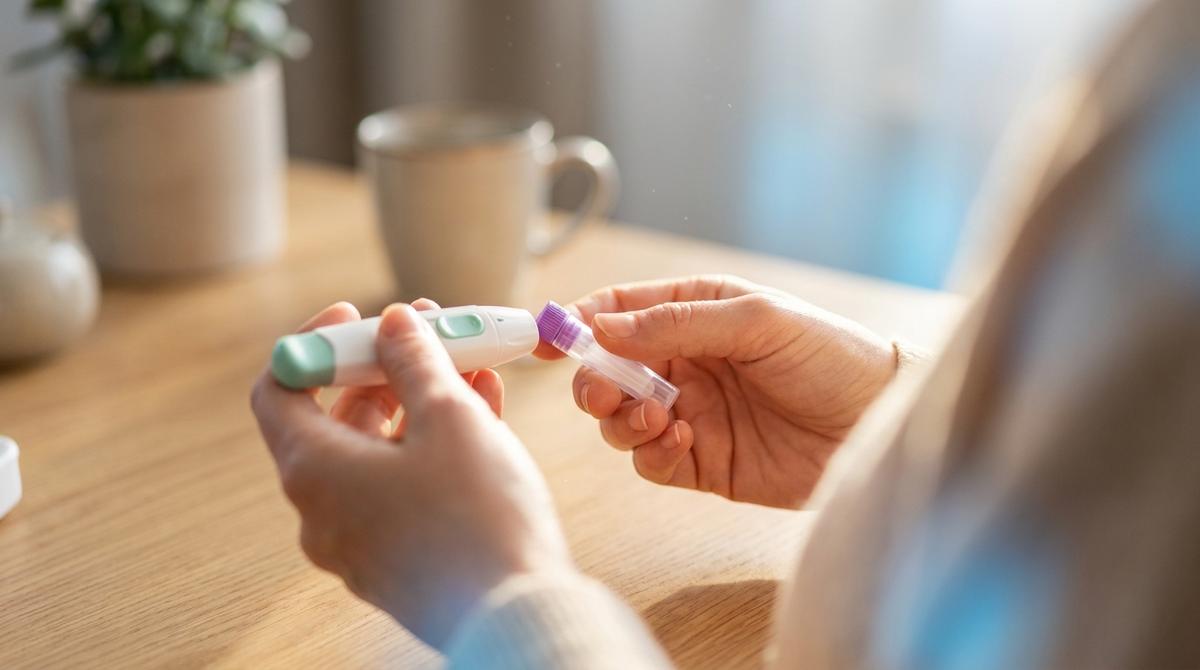
A drop of blood from your fingertip, plus a urine, stool or saliva sample depending on the profile. You do it at home whenever it suits you and send it back.
Analysis happens in a specialist medical laboratory — the same methods used in clinical practice.
You do not get a list of numbers but an interpretation: what stands out, what it means, what you can do — from a practitioner in the ORY expert network.
Some values cannot be determined from a drop of blood — a full blood count, for example. That is what the second route is for: a blood draw at a practitioner near you. Both routes feed into the same report.
You start with the kit. Whether a blood draw is added is decided afterwards — not before.
There are thirty tubs on the shelf. Every one of them says you need it. The truth is: you do not need most of them — and with one or two, something may genuinely be missing.
Which ones is written in your values. Not on the packaging.
After the measurement you get two things: a concrete recommendation on what to correct — and a nutrition proposal that fits your training and match rhythm. Both from a practitioner, not from a calculator.
Recommended supplements are on the Cologne List. The list does not rule out contamination; it lowers the risk.
Laboratory values are health data. They belong to the player — not to the team, not to the coach, not to the club.
That is why we keep it separate: the club gets the invoice. The player gets the report, through their own account. The coach gets neither.
For clubs and coaches →Specialist medical laboratory. Analysis does not happen in a start-up lab but where doctors and naturopaths send their samples too.
More than 130 laboratory values in the programme — from nutrients through hormones to the gut. We look for the cause, not just the symptom.
A network of practitioners who go through your values with you. Anyone with a profile there has completed our academy.
Functional medicine, not advice-column knowledge. We have worked with the same methods for patients for years. Athletes get the same care.
Every link depends on the previous one. Laboratory values show which link is currently running short.
Two axes running against each other: as load rises, the share of recovery falls — and the other way round. Where the point sits is accessible in the laboratory.
Four steps that repeat. That way you give your body precisely what is actually missing in you — instead of what the tub says.
Establish baseline values — a drop of blood from your fingertip, plus a urine, stool or saliva sample depending on the question. After that, where you stand is in black and white. Instead of a guess.
A practitioner goes through the values with you and decides what should change. Nutrition first — and targeted supplementation only where a deficiency was actually measured.
Build all of it into your training and match rhythm. A plan you cannot keep up alongside work, training and weekends is not a plan.
The same values again after a few weeks. Only the comparison shows whether anything has moved — or whether adjustment is needed.
And then it starts again.
Not because it never ends — but because a season changes and your values change with it. What was right in August need not be right in January.
We will send you a short guide: which nutrients regularly run short in indoor sports, how you would notice, and when measuring is worthwhile. Kept short, no sales copy.
The connections below describe general physiology and biochemistry as studied in the specialist literature. They say nothing about your personal status — that requires measurement and interpretation.
Carbohydrates, fats and proteins provide the raw material. Converting it into ATP — the form of energy muscle cells use — happens in the mitochondria. Vitamins and minerals act as cofactors in these steps: iron, zinc, selenium, copper and coenzyme Q10 are described in the literature as necessary for this conversion.
Oxidative metabolism, which works during longer efforts and in the recovery between sprints, depends on oxygen transport. Reviews describe iron as central to transporting and delivering oxygen in tissue; iron deficiency is therefore studied in connection with aerobic capacity.
Oxidative metabolism produces reactive oxygen species — a normal part of training and adaptation. The literature also describes that energy availability that stays too low over a longer period can go together with an inadequate intake of micronutrients. In the athlete groups studied, vitamin D is regularly described as running short.
The reviews are clear on this point: in well-supplied athletes, taking additional micronutrients does not improve performance according to the evidence, and a very high intake can interfere with the body's adaptation to training stimuli. Taking something becomes sensible where a deficiency has been established — and with a practitioner alongside. That is exactly why we measure first.
Training is a stimulus the body answers hormonally: the axis of hypothalamus, pituitary and adrenal gland controls, among other things, cortisol release across the day. In the literature on overreaching and overtraining, changes in this axis and the ratio of anabolic to catabolic hormones are studied as signs of incomplete recovery. Load and recovery are therefore measurable quantities, not just a feeling.
A large part of recovery happens during sleep; reviews study sleep loss in connection with performance and recovery in athletes. Biochemically, a path leads from the amino acid tryptophan via serotonin to melatonin, the hormone that helps control the sleep-wake rhythm. For the steps of this path the literature describes cofactors such as vitamin B6 and magnesium — and those are accessible in the laboratory.
The same meal is not processed the same way by everyone. One studied example is histamine metabolism: histamine occurs in food and is broken down in the body by enzymes, among them diamine oxidase in the gut. Where that breakdown is limited, the literature associates complaints after histamine-rich meals with it. A nutrition proposal that takes such pathways into account looks different from a standard plan.
The works cited describe general connections and do not refer to ORY Athletik. Laboratory values and their interpretation do not replace a medical diagnosis or treatment.